
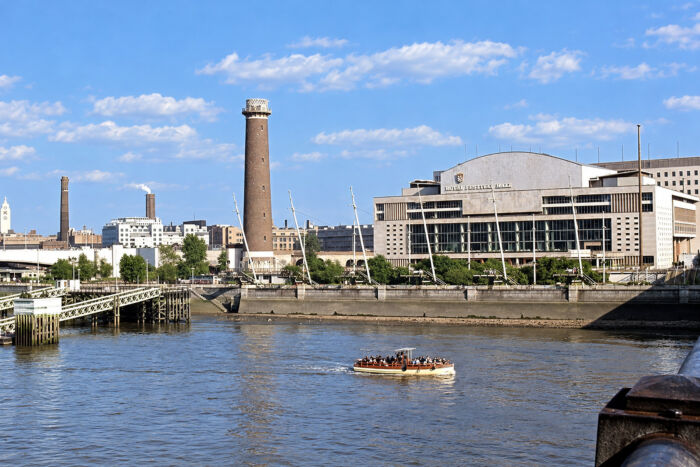
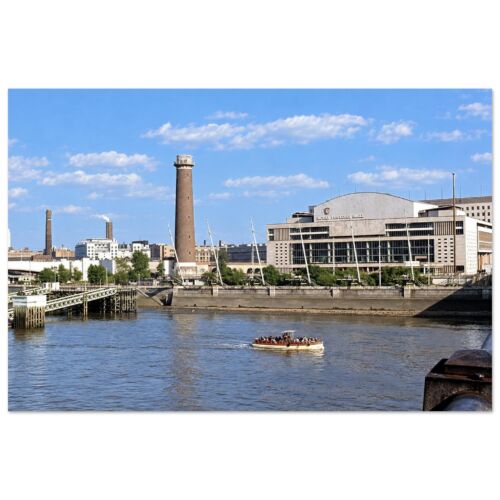


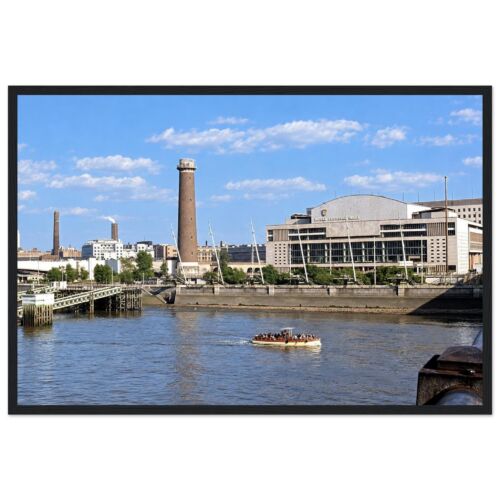


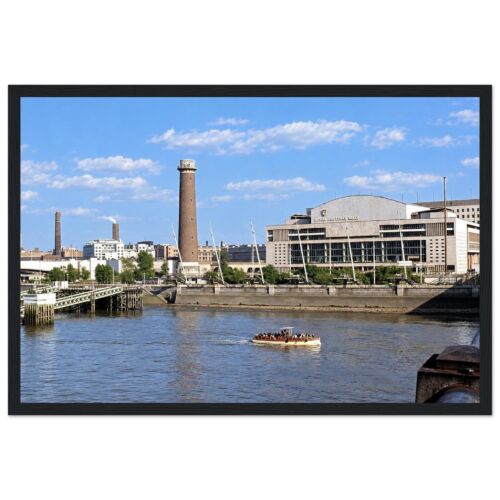

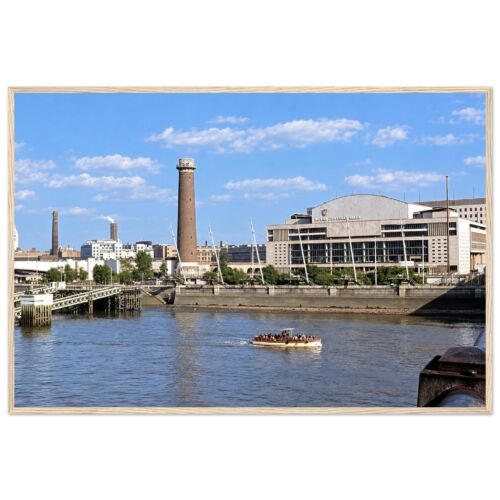


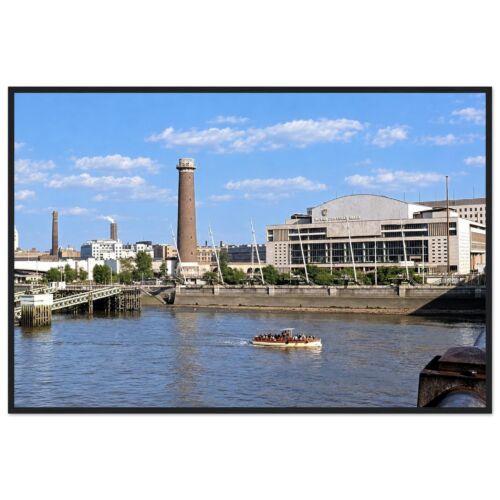
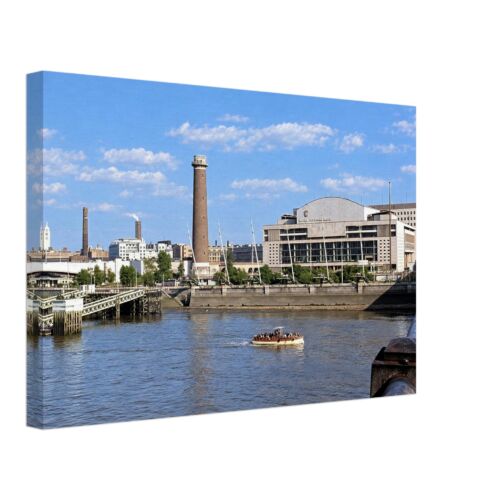
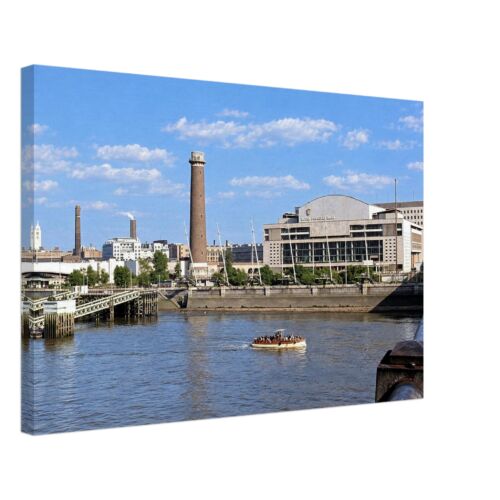
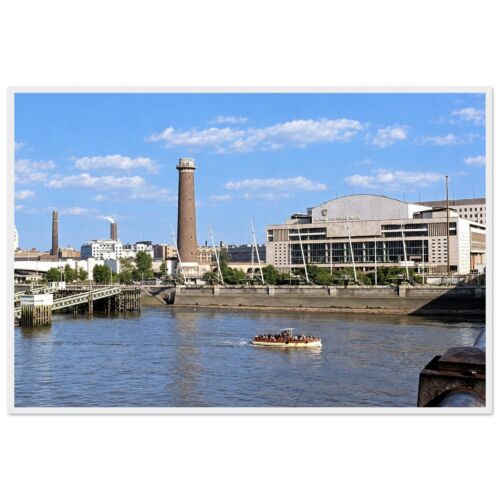


This spectacular genuine colour photograph from 1961 captures the Royal Festival Hall and the historic Shot Tower on London’s South Bank, just a year before the demolition of one of the area’s most distinctive industrial landmarks. Taken from across the River Thames, the photograph shows the magnificent modernist concert hall standing beside the tall cylindrical brick tower, while a small passenger boat cruises along the river in the foreground. With its brilliant blue sky, colourful riverside scene and contrasting architectural styles, the image preserves an extraordinary moment in the transformation of London’s South Bank.
The Royal Festival Hall was constructed between 1949 and 1951 as the centrepiece of the Festival of Britain, the ambitious national celebration of British achievements in industry, science, technology, architecture and the arts. Designed by a team of London County Council architects led by Leslie Martin under Robert Matthew, the concert hall was officially opened by King George VI on 3 May 1951. Unlike the temporary exhibition buildings surrounding it, the Royal Festival Hall was designed as a permanent cultural landmark and became the principal architectural legacy of the Festival on the South Bank.
Standing prominently beside the concert hall is the remarkable Shot Tower, a survivor from the area’s industrial past. Constructed in 1826 for Thomas Maltby & Company as part of the Lambeth Lead Works, the tower was designed by David Riddal Roper and originally stood approximately 163 feet high. Its purpose was the manufacture of lead shot, used principally in ammunition. Molten lead was dropped from a considerable height, forming almost perfectly spherical pellets as it fell through the air before being cooled in water at the bottom of the tower.
The Shot Tower had been a familiar feature of the South Bank skyline for more than a century before the Festival of Britain. When the extensive industrial premises surrounding it were cleared to make way for the 1951 exhibition, the tower was deliberately retained as the only existing building on the Festival site. Its original upper gallery was removed and replaced with a steel-framed structure carrying a radio beacon, transforming a nineteenth-century industrial building into an unusual feature of the modern exhibition. The contrast between the historic brick tower and the futuristic Festival architecture became one of the site’s most memorable visual features.
Following the closure of the Festival of Britain in September 1951, most of the temporary exhibition buildings were dismantled, but the Shot Tower continued to stand beside the Royal Festival Hall throughout the 1950s. By the time this photograph was taken in 1961, the South Bank was entering another phase of development, with plans progressing for new concert halls and art galleries. The tower was finally demolished in 1962 to clear the site for the Queen Elizabeth Hall, which opened in March 1967. Its disappearance marked the end of an important physical link with the South Bank’s industrial history.
The photograph offers a wonderful comparison between two very different periods of London’s architectural development. The nineteenth-century Shot Tower, with its plain brick shaft and distinctive castellated crown, stands beside the sweeping modernist façade of the Royal Festival Hall. In the foreground, the river embankment is lined with slender lighting columns and trees, while the passenger boat and distant industrial chimneys add further historical interest. The Royal Festival Hall itself had yet to undergo the substantial alterations and extensions carried out during the 1960s.
Another interesting feature is the relatively undeveloped appearance of the surrounding South Bank. The Queen Elizabeth Hall, Purcell Room and Hayward Gallery had not yet been built, while the National Theatre would not open until 1976. The photograph therefore captures the riverside between two major periods of construction, when the Royal Festival Hall remained the principal modern cultural building on the former Festival of Britain site.
Today, the Royal Festival Hall continues to serve as one of London’s leading concert venues, but the Shot Tower has long since disappeared. Its former presence is largely remembered through archive photographs, historic plans and contemporary accounts of the Festival of Britain. This remarkable 1961 image is particularly valuable because it records the two buildings together shortly before the tower’s demolition, preserving a view of the South Bank that can never be repeated.
More than simply a fascinating historical photograph, this colourful riverside scene makes a distinctive piece of wall art for the home, office, study or workplace. The dramatic contrast between the historic Shot Tower and the modern Royal Festival Hall is almost guaranteed to spark conversation, particularly among those familiar with London’s changing skyline. It would also make a thoughtful and unusual gift for that hard-to-buy-for friend or relative, especially anyone interested in the Festival of Britain, London’s lost landmarks, industrial archaeology, mid-century modern architecture or the history of the River Thames.
Reproduced from a genuine vintage colour photograph in the Places Remembered archive — not artificially coloured or AI-generated — this historic London wall art preserves a beautiful view of the Royal Festival Hall and the long-lost Shot Tower in 1961. A remarkable reminder of the South Bank’s industrial heritage and its transformation into one of Britain’s most important cultural destinations.
Genuine Vintage Colour Photography, Carefully Restored
Every Places Remembered print begins with a genuine vintage colour slide or negative from our private photographic archive. These are real photographs of real places, captured decades ago on colour film. We do not artificially colourise black-and-white photographs. The colours were present in the original images, rather than invented afterwards.
To bring these historic photographs back to life, we use modern digital restoration techniques, including AI-assisted enhancement, to improve sharpness, colour, brightness and clarity, and reduce dust, scratches and other age-related imperfections.
Our aim is restoration, not reinvention. We do not deliberately add or remove people, buildings, vehicles or other features, or dramatically alter scenes simply to make them more appealing. We may brighten a dull sky, enhance faded colours or improve clarity, but we strive to preserve the original photograph's historical character rather than create an idealised version of the past. AI-assisted enhancement can occasionally affect small details, even when that is not intended.
History is important to us. We're not trying to change it, but to preserve it through careful restoration. Our prints reproduce genuine historical colour photographs, not AI-generated recreations.
Whether you choose a photographic poster, a ready-to-hang canvas or a wood-framed print, the same authentic vintage photograph is at the heart of every option.
Three Ways to Enjoy Your Favourite Photograph
Our vintage photographs are available in three different print formats, allowing you to choose the presentation, finish and price that best suits your home.
Premium Matte Photographic Posters
Our photographic posters offer an affordable way to enjoy genuine vintage photography without compromising on print quality. Each photograph is reproduced on premium heavyweight 200 gsm (80 lb) white matte paper, giving it a substantial, high-quality feel.
The smooth, uncoated paper has a luxuriously soft finish and a non-reflective surface, helping to reproduce the rich colors and fine details of the original photograph without distracting reflections. At approximately 0.26 mm thick, it is considerably more substantial than ordinary lightweight poster paper.
Posters are supplied unframed and are sent rolled in a tube, making them an excellent choice if you already own a suitable frame or prefer to select your own framing style. They are also ideal for gifts, gallery walls and collections of several photographs.
Printed on FSC-certified or equivalent sustainably sourced paper.

Premium Ready-to-Hang Canvas Prints
Our premium canvas prints offer a more traditional wall-art presentation, with a subtly textured surface that adds depth and character to each vintage photograph. Printed on a durable 300–350 gsm cotton-polyester blend canvas, they reproduce the rich colors and fine details of the original image while providing the distinctive look and feel of canvas artwork.
The canvas has a beautiful matte, low-reflection finish that looks attractive under a wide range of lighting conditions. Unlike traditional framed prints, there is no glass or plexiglass covering the image, so you can enjoy the photograph without distracting reflections from windows or overhead lighting.
Each print is carefully stretched over a slim 2 cm (approximately 3/4-inch) wooden frame, made using responsibly sourced FSC-certified wood. The slim profile creates a clean, understated appearance that suits both traditional and contemporary interiors.
The photograph is softly mirrored around the edges, allowing the image to continue naturally around the sides without cropping important details from the front. Each canvas also includes a fitted sawtooth hanging bracket, so it can be displayed straight from the box.


Premium Wood-Framed Photographic Prints
For a beautifully finished presentation, our framed photographic prints combine premium heavyweight matte paper with a durable genuine pine wood frame. Each photograph is protected behind shatterproof plexiglass, helping to guard against dust and accidental damage while keeping the image clearly visible.
The photograph is printed on heavyweight 200 gsm (80 lb) white matte paper with a smooth, luxurious, non-reflective surface. The paper measures approximately 0.22 mm thick and reproduces the colors and fine details of the original vintage photograph beautifully.
The wooden frame has a slim, elegant profile, measuring approximately 20–25 mm deep and 10–14 mm wide. It complements the photograph without overpowering it, making these framed prints suitable for a wide range of interiors.
Choose from Black, White or Natural Wood frame finishes to suit your decor. Every framed print includes a hanging kit and arrives ready to display, making it a convenient choice for homes, offices, gifts and hospitality interiors.
The heavyweight paper is made using FSC-certified materials or equivalent. The protective plexiglass may produce some reflections depending on the lighting conditions in your room.

Which Print Format Is Right for You?
All three options reproduce the same genuine vintage photograph, but each offers a different look and presentation.
| Feature | Poster | Canvas | Framed Print |
|---|---|---|---|
| Print Material | Premium matte paper | Textured cotton-polyester canvas | Premium matte paper |
| Material Weight | 200 gsm | 300–350 gsm | 200 gsm |
| Finish | Smooth matte | Textured matte | Smooth matte |
| Presentation | Unframed | Stretched over wood | Solid pine frame |
| Protective Glazing | None | None | Shatterproof plexiglass |
| Ready to Hang | No | Yes | Yes |
| Frame Colours | Not applicable | Not applicable | Black, White, Natural Wood |
Posters are ideal if you want an affordable photographic print or prefer your own framing. Canvas prints offer a textured, low-reflection appearance without glass. Framed prints provide an elegant, ready-to-hang presentation with protective plexiglass.
From Our Original Photographic Archive
Every print is reproduced from a genuine vintage colour photograph in our own private archive. We own the original slides or negatives and the rights to the images, making these photographs exclusive to Places Remembered.
Wherever possible, our photographs are scanned directly from the original film, then carefully restored with digital tools, including AI-assisted enhancement. The original scenes were photographed in colour; they are not modern illustrations, artificially colourised black-and-white photographs or AI-generated recreations.
These are genuine moments from the past, carefully preserved and reproduced for today's walls.
Choose the Perfect Size
Whether you are decorating a smaller room or creating a striking feature wall, all three print formats are available in three sizes.
12×18" 30×45 cm
A versatile choice for bedrooms, kitchens, home offices, smaller walls and thoughtful gifts.
16×24" 40×60 cm
Ideal for creating a focal point in living rooms, bedrooms, offices and gallery walls.
24×36" 60×90 cm
Perfect above sofas, fireplaces and beds, or anywhere you want a historic photograph to become a conversation piece.
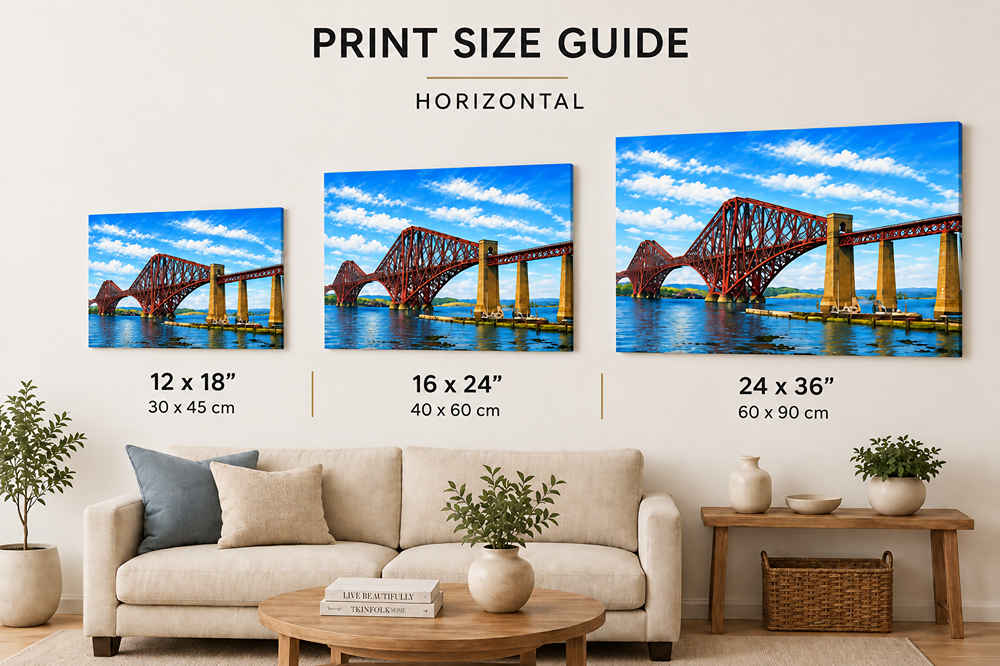
All sizes are approximate. The dimensions refer to the printed artwork. The overall external dimensions of framed prints will be slightly larger due to the frame.
Bulk Discount Available
Buying several prints for your home, workplace, vacation rental or hospitality interior? Purchase five or more prints and receive 15% off your order.
Our vintage photographic prints are also well suited to gift shops, cafés, hotels, restaurants, galleries and businesses looking for distinctive historic wall art.
Made to Order with Free Shipping
Every photographic poster, canvas and framed print is produced individually to order. This avoids unnecessary stock and ensures that each print is made specifically for you.
We offer free shipping to the USA and UK. Please allow approximately 7–14 days for production and delivery, although times may vary depending on the destination and print format.
Reviews
There are no reviews yet.